Mortgage Pre-Approval in Indiana: How to Get Pre-Approved (and the Documents You Need)
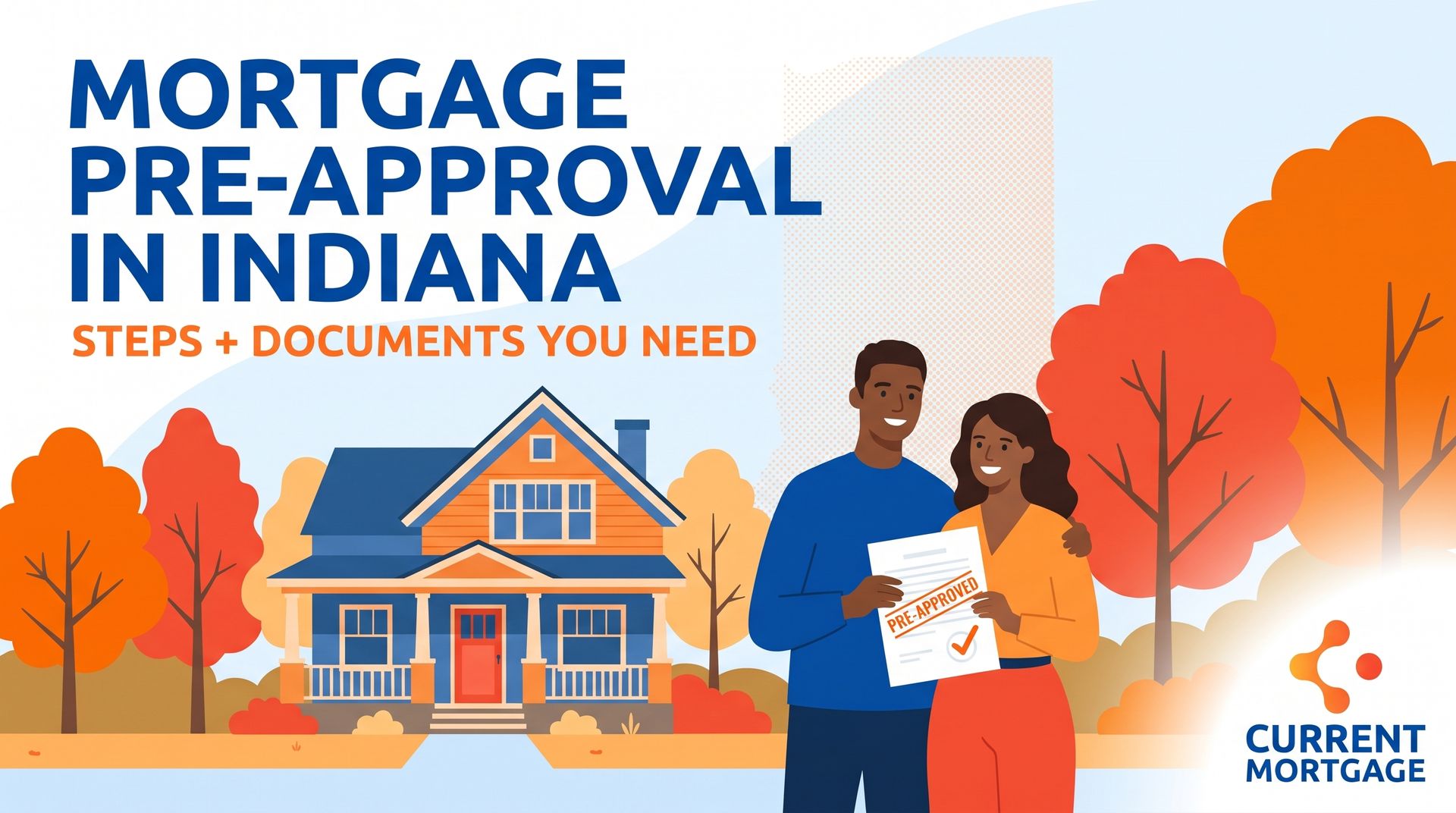
Mortgage Pre-Approval in Indiana: How to Get Pre-Approved (and the Documents You Need)
The quick answer
To get pre-approved for a mortgage in Indiana, you check your credit, gather your income and asset documents, and apply with a licensed Indiana loan officer who verifies them and pulls your credit. Most W-2 buyers need a photo ID, 30 days of pay stubs, two years of W-2s, and two months of bank statements. Self-employed buyers may qualify with 12 or 24 months of bank statements, a CPA-prepared profit and loss statement, or 1099s, depending on the scenario.
The key numbers to know:
- Down payment: some first-time buyer programs require as little as 3% down.
- Closing costs: budget an extra 2% to 5% of the loan amount.
- Credit score: depends on the loan program. One down payment assistance program Greg offers starts at a 600 score, and his non-QM option starts at 620.
- After you're pre-approved: no new credit, no new car, no job change until you close.
Put the Zillow app down
You found the house. Three bedrooms, a fenced yard, twenty minutes from work in Fishers. You're already picturing where the couch goes.
Here's the problem. If you walk into that showing without a pre-approval letter, the seller isn't picturing you at all. In a competitive Central Indiana market, an offer without a pre-approval is just a wish.
I'm Greg Pilling, founder of Current Mortgage in Carmel. I've spent more than ten years in the mortgage industry and served as President of the Indiana Mortgage Bankers Association. And the number one thing I tell every buyer is the same: get pre-approved before you fall in love with a house, not after.
This guide walks you through exactly how mortgage pre-approval works in Indiana, the documents you'll need, and the one mistake that can cancel your loan at the finish line.
What is mortgage pre-approval, and how is it different from pre-qualification?
A mortgage pre-approval means a lender has actually verified your income, assets, and credit and states how much you can likely borrow. A pre-qualification is an estimate based on what you tell the lender, with nothing checked.
I call a pre-qualification a financial vibes check. It feels nice, but it doesn't prove anything. A pre-approval means the lender has looked at your real pay stubs and tax returns.
Pre-qualification:
- What the lender checks: what you say you earn and own.
- How sellers see it: a rough guess.
- Best for: early budgeting.
Pre-approval:
- What the lender checks: your actual pay stubs, W-2s or tax returns, bank statements, and credit.
- How sellers see it: proof you have the money to back up your offer.
- Best for: making an offer on a house in Indiana.
Why does this matter? When you hand an Indiana seller a pre-approval letter, it proves you can back up your offer, and they take you seriously. That's the whole game when another buyer is bidding on the same house.
How do you get pre-approved for a mortgage in Indiana? 5 steps
Getting pre-approved in Indiana takes five steps: know your credit, gather documents, set a real budget, apply with a licensed Indiana loan officer, and get your letter.
- Know your credit score before I do. Your credit dictates your entire loan, from the programs you qualify for to your rate. Check it early. If it needs work, don't panic. There's time to fix it before you apply.
- Gather your documents. The full checklist is in the next section. Having it ready is the fastest way to get a letter in hand.
- Run the full math, not just the rate. Your monthly payment includes principal, interest, property taxes, and insurance, plus mortgage insurance on many low down payment loans. Property taxes are the silent budget ninja: they can rise after a reassessment and push your payment up, even on a 30-year fixed.
- Apply with a loan officer licensed in Indiana. A mortgage broker like Current Mortgage can compare programs from multiple lenders, so you aren't stuck with one bank's limits. Expect a credit pull during this step.
- Get your pre-approval letter and start shopping. Your letter shows sellers the loan amount you're approved for, depending on final underwriting and the property itself.
One honest note: a pre-approval is not a final approval. The house still needs to appraise, and your finances need to stay the same until closing. More on that below.
What documents do you need for mortgage pre-approval in Indiana?
For a mortgage pre-approval in Indiana, most buyers need proof of identity, proof of income, proof of assets, and permission to pull credit. Exact requirements depend on the loan program and your scenario.
If you're a W-2 employee:
- Government-issued photo ID (driver's license or passport)
- Social Security number and permission to pull your credit
- Pay stubs covering your most recent 30 days
- W-2s from the past two years
- Federal tax returns from the past two years, if requested
- Bank and investment account statements from the past two months, all pages
- Gift letter, if family is helping with your down payment
If you're self-employed or a 1099 earner:
Traditional loans lean hard on tax returns. That's a problem when your write-offs make you look broke on paper. Here's the cheat code: alternative documentation programs can qualify you using one of these instead, depending on your scenario.
- 12 or 24 months of personal or business bank statements
- A profit and loss statement prepared by your CPA or tax preparer
- One or two years of 1099s
If you've had a past credit event:
A bankruptcy, foreclosure, or short sale doesn't always mean waiting seven years. Some programs allow a major credit event to be seasoned for just 12 to 48 months, depending on your scenario. Bring the paperwork showing when it was discharged or completed.
Why underwriters care about where your money came from: large cash deposits without a clear paper trail generally can't be used toward your loan. Keep your money in the bank and keep receipts for any big transfers.
How much credit and cash do you need to get pre-approved in Indiana?
The credit score and down payment you need depend on the loan program, and the 20% down rule is a myth. Plenty of Indiana buyers get pre-approved with far less.
Down payment: Some first-time buyer programs require as little as 3% down. Twenty percent is not the minimum. It's just the point where you avoid private mortgage insurance on a conventional loan.
Closing costs: Budget an extra 2% to 5% of the loan amount for title fees, prepaid property taxes, and other costs. This is the number first-time buyers forget most.
Credit score: Minimums vary by program. A few real examples from programs Greg works with:
- NHF National FHA down payment assistance: 600 minimum credit score. No income limits, and first-time and repeat buyers are eligible for a primary residence.
- Alternative documentation (non-QM) loan: 620 minimum credit score. Qualify with bank statements, a P&L, or 1099 income, with loans up to $4 million for a primary home and $2.5 million for a second home.
All terms depend on your scenario and can change.
Down payment assistance in Indiana: The NHF National FHA program lets you choose between two options. One is a repayable second mortgage of up to 5% of the price or appraised value, whichever is less, paid back over 10 years. The other is a 3.5% soft second at 0% interest with no monthly payment, forgiven after 3 years if you keep living in the home and don't sell or refinance.
Indiana's state housing agency, IHCDA, also runs its own programs. Its First Step program offers qualifying first-time buyers 5% of the home price in down payment assistance, and its Next Home program offers up to 3.5%. Heads up: many websites still advertise IHCDA's First Place program, but it ended on December 31, 2023. Income and purchase price limits apply, so ask your loan officer which program fits your scenario.
You're pre-approved. Sounds perfect, right?
Here's the catch: you're conditionally approved until you're not. A pre-approval can fall apart before closing if your finances change, so my absolute golden rule is total credit silence from application to closing table.
These seven moves can get a loan cancelled at the finish line:
- Buying a car. A new car payment can tank your debt-to-income ratio instantly.
- Opening new credit cards. Even for double points or a new living room set. New credit triggers an inquiry and adds debt.
- Changing jobs. Moving from salary to 100% commission, or into a new field, resets the stability underwriters look for.
- Making large untraceable cash deposits. Without a paper trail, underwriters can't use those funds.
- Missing a payment. One 30-day late payment on a card or rent drops your score right when you need it most.
- Co-signing for someone else. Even if they promise to pay, that debt counts against you.
- Closing old credit cards. It shrinks your available credit and shortens your credit history. Use the sock drawer strategy instead: pay the card to zero, keep it open, and hide it in your sock drawer.
And please do not quit your job to start a podcast. If you truly need to make a big financial move, talk to your loan officer first.
Mortgage pre-approval in Indiana: FAQ
How long does a mortgage pre-approval last in Indiana? Most pre-approval letters are good for about 60 to 90 days, depending on the lender. If yours expires before you find a house, your loan officer can update it with fresh pay stubs and bank statements.
Does getting pre-approved hurt my credit score? A pre-approval usually involves a hard credit pull, which can lower your score by a few points for a short time. Credit scoring models generally count multiple mortgage inquiries within a short shopping window as one, so comparing lenders won't stack up damage.
What's the difference between pre-qualified and pre-approved? Pre-qualification is an estimate based on what you tell a lender. Pre-approval means the lender verified your income, assets, and credit. Sellers take pre-approval seriously.
Can I get pre-approved in Indiana if I'm self-employed? Yes. Alternative documentation programs can qualify you with 12 or 24 months of bank statements, a CPA-prepared profit and loss statement, or 1099s instead of tax returns, depending on your scenario.
Do I have to be a first-time homebuyer to get down payment assistance in Indiana? Not always. The NHF National FHA program has no income limits and is open to first-time and repeat buyers buying a primary residence, with a 600 minimum credit score.
Can I get pre-approved after a bankruptcy or foreclosure? Often, yes. Some programs allow a bankruptcy, foreclosure, or short sale to be seasoned for 12 to 48 months instead of seven years, depending on your scenario.
How much do I need for closing costs in Indiana? Budget 2% to 5% of the loan amount on top of your down payment.
Where does Current Mortgage lend? Current Mortgage is based in Carmel and serves Central Indiana, including Carmel, Fishers, Zionsville, Noblesville, Indianapolis, and Hamilton County. Greg also lends in Michigan and Utah.
Get pre-approved with a lender who explains the math
Buying a house is massive. Surround yourself with a real estate agent and a loan officer who will actually explain the math to you, not just quote a rate.
If you're buying in Indiana, Michigan, or Utah, reach out and we'll do the actual math together. Call 463-223-9919 or email greg@currentmortgage.ai.
About the author: Greg Pilling is the founder of Current Mortgage, a Carmel, Indiana mortgage broker with access to multiple lenders. He has more than 10 years in the mortgage industry, served as President of the Indiana Mortgage Bankers Association (2023–24), and remains on its board. He started Current Mortgage to use technology to cut delays while keeping service personal. Outside the office, he competes in the Scottish Highland Games.
Greg Pilling, NMLS #873570. Current Mortgage, NMLS #2554422. 200 S Rangeline Rd #129, Carmel, IN 46032. This article is for educational purposes only. It is not a commitment to lend. Rates, programs, and eligibility depend on your scenario and are subject to change.